
BharatAds
International
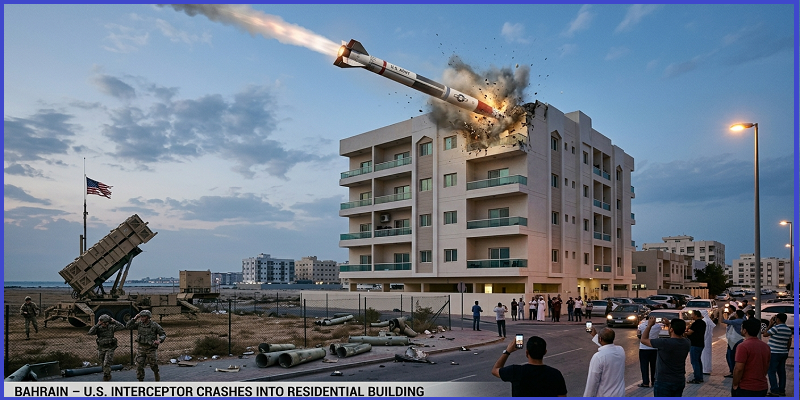
An U.S. Patriot Air Defense system deployed in Bahrain can be clearly seen crashing directly into the building
As you can see in the picture, it is not an Iranian missile hitting the building. Instead, an interceptor missile from the U.S. Patriot Air Defense system deployed in Bahrain can be clearly seen crashing directly into the building.
In other words, what the enemy isn't doing, the ally is doing. If this video and these claims are accurate, it raises the question: how is this even happening?
The U.S. Patriot Air Defense System is designed to intercept and shoot down enemy targets—such as Iranian ballistic missiles, cruise missiles, and aircraft—in mid-air. However, if an interceptor misses its target or its guidance system fails mid-flight, its self-destruct mechanism should trigger so that it explodes in the sky rather than crashing to the ground.
Under certain circumstances, however, the American interceptor does not completely destroy itself because the self-destruct mechanism either fails or acts late. As a result, debris—or sometimes the entire intact missile—plummets straight to the ground. Since this missile also carries explosives, it causes similar explosions upon impact.
Social media claims surrounding this missile state that an American Patriot missile defense interceptor was trying to lock onto and pursue an Iranian missile. However, the clever Iranian missile performed evasive maneuvers and slipped away, leaving the Patriot interceptor to lose its trajectory. The stray missile then ended up crashing into a residential building in Bahrain.
While independent verification of this claim is currently unavailable, it is unlikely that the U.S. would ever admit that its Patriot missile struck a friendly residential area. If true, this wouldn't be the first time. Similar incidents have occurred previously in Saudi Arabia, Kuwait, Ukraine, and Israel, where debris or whole failed interceptor missiles crashed into residential zones.
Ballistic missile defense is among the most challenging military technologies globally. Interceptors must collide directly with an incoming missile travelling at thousands of kilometers per hour within seconds—much like hitting an arrow with another arrow in ancient times. It is not enough to simply detect the target; the system must accurately calculate its speed, trajectory, and maneuvers. Calculating maneuvers is particularly difficult when the incoming missile constantly alters them.
This is why even the world's most advanced air defense systems cannot guarantee a 100% success rate for every interception. Although this video lacks official confirmation, if true, it highlights that American air defense systems are not entirely error-free during wartime. Sometimes, a system intended to protect can end up causing more damage to a friendly area than the target missile itself, as the original threat was headed toward a military target rather than a residential zone. War is a state of great uncertainty, and paper-proven technology does not always guarantee successful real-world interceptions.
In other words, what the enemy isn't doing, the ally is doing. If this video and these claims are accurate, it raises the question: how is this even happening?
The U.S. Patriot Air Defense System is designed to intercept and shoot down enemy targets—such as Iranian ballistic missiles, cruise missiles, and aircraft—in mid-air. However, if an interceptor misses its target or its guidance system fails mid-flight, its self-destruct mechanism should trigger so that it explodes in the sky rather than crashing to the ground.
Under certain circumstances, however, the American interceptor does not completely destroy itself because the self-destruct mechanism either fails or acts late. As a result, debris—or sometimes the entire intact missile—plummets straight to the ground. Since this missile also carries explosives, it causes similar explosions upon impact.
Social media claims surrounding this missile state that an American Patriot missile defense interceptor was trying to lock onto and pursue an Iranian missile. However, the clever Iranian missile performed evasive maneuvers and slipped away, leaving the Patriot interceptor to lose its trajectory. The stray missile then ended up crashing into a residential building in Bahrain.
While independent verification of this claim is currently unavailable, it is unlikely that the U.S. would ever admit that its Patriot missile struck a friendly residential area. If true, this wouldn't be the first time. Similar incidents have occurred previously in Saudi Arabia, Kuwait, Ukraine, and Israel, where debris or whole failed interceptor missiles crashed into residential zones.
Ballistic missile defense is among the most challenging military technologies globally. Interceptors must collide directly with an incoming missile travelling at thousands of kilometers per hour within seconds—much like hitting an arrow with another arrow in ancient times. It is not enough to simply detect the target; the system must accurately calculate its speed, trajectory, and maneuvers. Calculating maneuvers is particularly difficult when the incoming missile constantly alters them.
This is why even the world's most advanced air defense systems cannot guarantee a 100% success rate for every interception. Although this video lacks official confirmation, if true, it highlights that American air defense systems are not entirely error-free during wartime. Sometimes, a system intended to protect can end up causing more damage to a friendly area than the target missile itself, as the original threat was headed toward a military target rather than a residential zone. War is a state of great uncertainty, and paper-proven technology does not always guarantee successful real-world interceptions.