
BharatAds
Research and Innovation
Bihar scientist turned discarded mango seeds into a high-value SAP, patented green technology
Bhagalpur, Bihar
The $9.66 Billion Global Market
The Industry: The video introduces the global Super Absorbent Polymer (SAP) industry, valued at around $9.66 billion (~₹80,000 crores INR). Major chemical conglomerates like Germany's BASF and Japan's Nippon Shokubai operate billion-dollar plants to produce these water-absorbing polymers.
The Environmental Cost: The problem with these traditional commercial SAPs is that they are petroleum-based. They act like plastic, remaining in the soil for years and causing long-term environmental degradation.
The Problem in India: Wasted Potential
Massive Waste: India is the world's largest producer of mangoes, accounting for nearly 45% of global production (about 26.3 million tons). Bihar alone ranks third in India, producing 15.84 lakh metric tons.
Discarded Seeds: The inner seed (kernel) makes up 20% to 25% of a mango's total weight. Millions of tons of these seeds end up rotting on streets and in dumpsters every year after the summer mango season ends.
The Breakthrough Innovation in Bihar
The Visionary Team: Witnessing this massive seasonal waste, Director of Research Dr. A.K. Singh and scientist Dr. V. Shajida Banu from the Bihar Agricultural University (BAU) in Sabour, Bhagalpur, decided to find a solution. They asked: If global giants can make water-retaining gels from petroleum, why can't we make them naturally from discarded mango seeds?
The Trial Phase: The team spent months in the lab failing, testing formulas, adjusting temperatures, and changing molecular ratios. Eventually, they hit the perfect ratio, creating a natural hydrogel capable of absorbing 400 to 500 times its own weight in water.
The Legal Protection: This process was officially recognized and granted an Indian government patent under the title "A method for preparing hydrogel from mango seed kernel powder".
How the Eco-Friendly Hydrogel Works
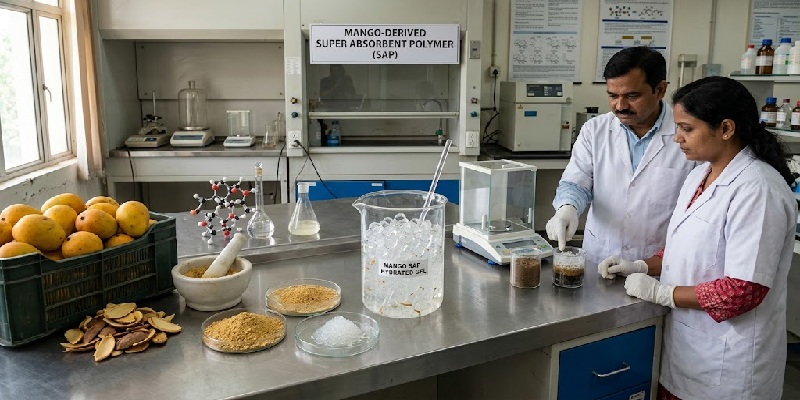
Step 1..Extracting the Kernel: Discarded mango seeds are thoroughly washed, and the tough outer shell is cracked open to extract the soft inner core (the kernel). Out of 1 ton of raw seeds, they yield about 100 to 120 kg of raw kernel.
Step 2.Milling into Powder: The extracted kernels are dried—either under the sun or using specialised drying machines—and finely milled into a smooth kernel powder packed with natural starch polymers.
Step 3.Chemical Cross-Linking: In the laboratory, the starch undergoes a "cross-linking" process. This binds the loose molecular chains together into a rigid 3D grid structure that behaves like a molecular fishing net, trapping water molecules inside.
Economic Impact & Agricultural Benefits
Value Addition: Turning raw mango seed waste into specialised hydrogel increases its economic market value by 5 to 7 times.
Boost to Rural Economy: The university estimates that if just 25% of the wasted mango seeds in Bihar and Eastern India were collected and processed, it could generate an extra ₹300 to ₹400 crore INR annually in supplementary income for local farmers and rural entrepreneurs.
A Boon for Drylands: Unlike petroleum-based alternatives that pollute the soil, this organic hydrogel acts as a slow-release "moisture bank" right at the crop roots [03:45]. It degrades completely into the soil after a single crop season, leaving zero toxic residue while significantly slashing irrigation frequency and costs in drought-prone regions.
The $9.66 Billion Global Market
The Industry: The video introduces the global Super Absorbent Polymer (SAP) industry, valued at around $9.66 billion (~₹80,000 crores INR). Major chemical conglomerates like Germany's BASF and Japan's Nippon Shokubai operate billion-dollar plants to produce these water-absorbing polymers.
The Environmental Cost: The problem with these traditional commercial SAPs is that they are petroleum-based. They act like plastic, remaining in the soil for years and causing long-term environmental degradation.
The Problem in India: Wasted Potential
Massive Waste: India is the world's largest producer of mangoes, accounting for nearly 45% of global production (about 26.3 million tons). Bihar alone ranks third in India, producing 15.84 lakh metric tons.
Discarded Seeds: The inner seed (kernel) makes up 20% to 25% of a mango's total weight. Millions of tons of these seeds end up rotting on streets and in dumpsters every year after the summer mango season ends.
The Breakthrough Innovation in Bihar
The Visionary Team: Witnessing this massive seasonal waste, Director of Research Dr. A.K. Singh and scientist Dr. V. Shajida Banu from the Bihar Agricultural University (BAU) in Sabour, Bhagalpur, decided to find a solution. They asked: If global giants can make water-retaining gels from petroleum, why can't we make them naturally from discarded mango seeds?
The Trial Phase: The team spent months in the lab failing, testing formulas, adjusting temperatures, and changing molecular ratios. Eventually, they hit the perfect ratio, creating a natural hydrogel capable of absorbing 400 to 500 times its own weight in water.
The Legal Protection: This process was officially recognized and granted an Indian government patent under the title "A method for preparing hydrogel from mango seed kernel powder".
How the Eco-Friendly Hydrogel Works
Step 1..Extracting the Kernel: Discarded mango seeds are thoroughly washed, and the tough outer shell is cracked open to extract the soft inner core (the kernel). Out of 1 ton of raw seeds, they yield about 100 to 120 kg of raw kernel.
Step 2.Milling into Powder: The extracted kernels are dried—either under the sun or using specialised drying machines—and finely milled into a smooth kernel powder packed with natural starch polymers.
Step 3.Chemical Cross-Linking: In the laboratory, the starch undergoes a "cross-linking" process. This binds the loose molecular chains together into a rigid 3D grid structure that behaves like a molecular fishing net, trapping water molecules inside.
Economic Impact & Agricultural Benefits
Value Addition: Turning raw mango seed waste into specialised hydrogel increases its economic market value by 5 to 7 times.
Boost to Rural Economy: The university estimates that if just 25% of the wasted mango seeds in Bihar and Eastern India were collected and processed, it could generate an extra ₹300 to ₹400 crore INR annually in supplementary income for local farmers and rural entrepreneurs.
A Boon for Drylands: Unlike petroleum-based alternatives that pollute the soil, this organic hydrogel acts as a slow-release "moisture bank" right at the crop roots [03:45]. It degrades completely into the soil after a single crop season, leaving zero toxic residue while significantly slashing irrigation frequency and costs in drought-prone regions.